


 Deutsch
Call Us
TEl: +86-13148388090
Fax:+86-571-88616515

In continence care clinics, one of the most common questions from patients is about failed intermittent catheter drainage. The concern usually appears suddenly—often in the bathroom, when a patient expects urine to flow but nothing happens. The bladder feels full; the catheter appears correctly inserted, yet drainage stops or never begins. Usually, it happens to patients during the first year of self-catheterization.
But do not worry: in most cases, the problem is mechanical, behavioral, or anatomical, not a medical emergency. To help ease your concerns, we have compiled a practical troubleshooting guide for your reference.
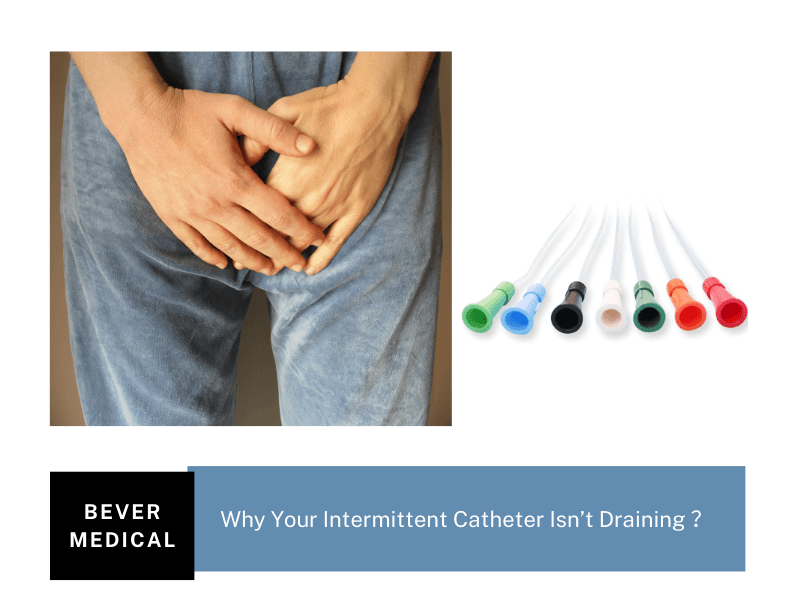
One of the main reasons is incomplete insertion. Urine only enters through the eyelets near the catheter tip. If those holes remain in the urethra rather than inside the bladder, nothing drains. Sometimes, it just advances the catheter 2–3 cm further, and urine begins to flow immediately. The standard catheter visible after insertion for men is around 10 cm (4 in), and for women, 2–3 cm is visible.
Common for patients who use external lubrication catheters. Gel can temporarily block the tiny drainage holes. Because most lubricants are water-soluble, urine will usually dissolve the obstruction within 30–60 seconds. You or your patients can try to cough. Coughing increases abdominal pressure, helping urine push through the eyelets.
If you worry about it, Hydrophilic catheters are a good choice; they reduce this problem significantly. Many clinicians therefore prefer a hydrophilic intermittent catheter for patients performing frequent catheterization.
You can imagine what will happen when your tube is not on a straight path; yes, it means no urine flow. Think about the reasons:
This is especially common in long male catheters (40 cm).
Over time, urinary minerals can form crystalline deposits.
Common components include:
These deposits can partially block eyelets, especially in patients with:
This is why your single-use catheter manufacturer strongly recommends it in America.
Reusing catheters increases the risk of:
Medical suppliers often emphasize sterile single-use intermittent catheters to reduce these risks.
This mistake occurs more often than many clinicians expect.
In female patients, the urethral opening is small and positioned just above the vaginal opening.
New catheter users sometimes insert the catheter into the vagina accidentally.
If the catheter goes in easily but nothing drains, remove it and try again with new sterile intermittent catheters for women.
Never reuse a catheter that has entered the vagina because bacteria may be introduced into the bladder.
It sounds obvious—but it happens frequently. Kidneys produce urine continuously, but not always enough to trigger drainage. Many patients catheterize too early, before the bladder fills. Typical adult bladder capacity is 400–600 mL. Most clinicians recommend catheterizing every 4–6 hours, unless directed otherwise. If the catheter drains only a few drops, the bladder may simply not be full yet.
Catheters are measured in French size (Fr). Knowing these common ranges:
Above are typical sizes for different groups; a catheter that is too narrow may collapse under pressure. One that is too large may irritate the urethra and prevent smooth insertion.
Experienced clinicians often adjust catheter size based on urine flow, patient comfort and urethral anatomy.
Self-catheterization can cause anxiety. When patients tense their pelvic muscles, the urethral sphincter tightens, making insertion difficult. Urology nurses often teach patients to:
This factor is rarely discussed but extremely important.
The rectum sits directly behind the bladder.
Severe constipation can:
In rehabilitation centers, clinicians often address constipation before adjusting catheter technique. So, trying dietary fiber and hydration play a critical role here.
A subtle but interesting phenomenon occurs after drainage.
The bladder is not a perfectly round balloon.
Instead, it has a funnel-shaped base near the urethra.
Some urine may remain trapped in lower pockets.
Patients sometimes notice that if they withdraw the catheter slightly, more urine dribbles out.
Urology specialists sometimes recommend:
This technique helps achieve more complete drainage.
Although most drainage problems are minor, certain symptoms should trigger immediate medical evaluation:
These may indicate a urinary tract infection (UTI) or catheter blockage.
Before diagnosing the problem, it helps to know the pathway urine follows.
Basic drainage pathway
Kidneys → Bladder (stores urine) → Catheter eyelets (small holes near the tip) → Catheter tube → Drainage funnel/bag/toilet
For urine to flow properly, we suggest:
When any part of this sequence fails, drainage stops.
When an Intermittent catheter fails to drain, in most cases, the issue relates to insertion depth, catheter positioning, minor blockages, or simple technique adjustments during self-catheterization. A few millimeters of catheter placement can make the difference between frustration and relief. With this article, you can know better about how these factors can transform what initially feels like a stressful or alarming situation into a manageable part of routine bladder care. For clinicians, distributors, and manufacturers alike, patient education remains just as important as advances in catheter technology.
OEM and Private Label Support
For distributors, importers, and medical device companies looking to expand their continence care portfolio, partnering with an experienced OEM manufacturer can simplify product sourcing while ensuring consistent quality and reliable supply.
In addition to offering a comprehensive range of intermittent catheters, BEVER Medical provides OEM and private label manufacturing services tailored to different market requirements. From product customization and private labeling to packaging support and quality-controlled production, the company works with global partners to develop continence care solutions for hospitals, distributors, and healthcare providers.
Copyright © Hangzhou BEVER Medical Devices Co., Ltd.
The information provided on this website is intended for use only in countries and jurisdictions outside of the People's Republic of China.


