


 Deutsch
Call Us
TEl: +86-13148388090
Fax:+86-571-88616515
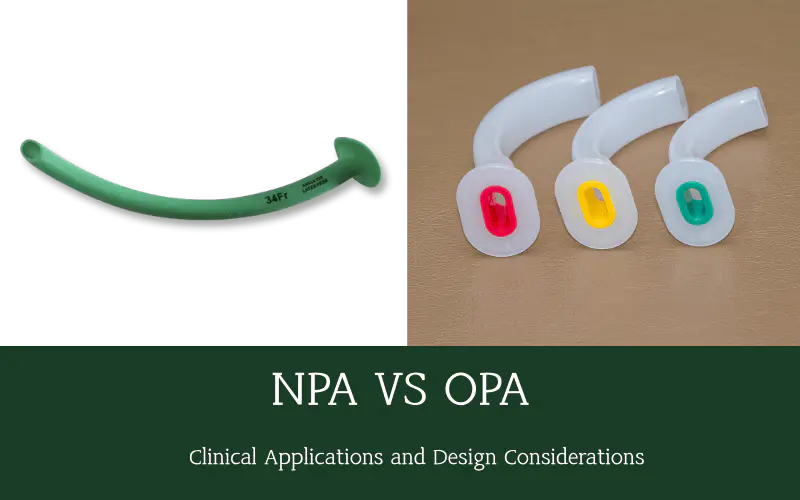
Maintaining a patent airway is a fundamental priority in emergency care, anesthesia, and critical care. Among basic airway adjuncts, nasopharyngeal airways (NPA) and oropharyngeal airways (OPA) are widely used to help prevent upper airway obstruction caused by soft tissue collapse. Although these devices are simple in concept, their effective use depends on understanding not only when to use them, but also why they are designed the way they are.
This article explores NPA and OPA from a practical perspective, focusing on application scenarios, material selection, and design philosophy, and concludes with guidance on patient suitability.
Nasopharyngeal airways (NPA) are inserted through the nasal passage and extend into the nasopharynx to maintain airflow. Oropharyngeal airways (OPA), by contrast, are inserted through the mouth and rest over the tongue to prevent it from occluding the airway.
Both devices are intended to support spontaneous breathing and are commonly used as temporary airway adjuncts in emergency and clinical settings.
The choice between NPA and OPA is driven primarily by patient condition and tolerance.
NPA is often used in patients who are semi-conscious or who retain protective airway reflexes. Because it bypasses the oral cavity, it is generally better tolerated and less likely to provoke gagging in these patients. NPA is also useful when oral access is limited due to clenched teeth, oral trauma, or restricted mouth opening.
OPA is typically indicated for unconscious patients who lack a gag reflex. In these cases, OPA provides reliable tongue displacement and helps maintain airway patency with minimal resistance.
In emergency and prehospital environments, the clinical setting itself also influences device selection. Time pressure, patient cooperation, and limited resources often favor the device that can be placed quickly and safely while minimizing complications.
Material selection for nasopharyngeal airways (NPA) and oropharyngeal airways (OPA) is based on anatomical pathways and clinical use rather than a fixed material rule.
PVC is widely used for NPA due to its cost-effectiveness and suitability for single-use applications. Pre-lubricated PVC NPA are commonly adopted to support smoother nasal insertion in emergency and routine care settings.
Medical-grade silicone NPA are also available when enhanced softness and patient tolerance are required, particularly for sensitive patients.
OPA are predominantly manufactured from PVC for disposable clinical use, as they are typically applied in unconscious patients for short-term airway support where firmness and stable tongue displacement are essential. Silicone OPA exist mainly in limited or reusable formats and are not commonly used in routine disposable airway management.
The design of airway adjuncts reflects anatomical and functional considerations.
NPA is designed with a gentle curvature to follow the natural anatomy of the nasal passage. Features such as a flared proximal end or adjustable flange help prevent over-insertion and enhance positioning safety. Length and diameter options allow clinicians to select an appropriate size for different patient populations.
OPA design focuses on effective tongue displacement while minimizing pressure on oral structures. The curved profile mirrors oral anatomy, and reinforced bite sections help maintain patency even in patients with jaw movement.
These design elements are not arbitrary; they are intended to balance airway effectiveness with patient safety and tolerance.
Understanding these strengths and limitations helps reduce complications and improve clinical outcomes.
No single airway adjunct is appropriate for all patients. NPA is often better suited for patients who are partially conscious, elderly, or unable to tolerate oral devices. OPA remains a valuable option for deeply unconscious patients who require immediate and effective airway support.
Ultimately, airway adjunct selection should be based on patient assessment, risk evaluation, and clinical context rather than habit or convenience.
To support diverse clinical requirements, BEVER Medical offers a range of nasopharyngeal airway products designed with different materials and functional features.
These include adjustable NPA designs that allow flexible positioning, PVC NPA with pre-lubricated surfaces for ease of insertion, and medical-grade silicone NPA options developed to enhance patient comfort and biocompatibility. By offering multiple configurations, BEVER Medical aims to support clinicians in selecting airway solutions that align with specific patient needs and care environments.

Nasopharyngeal and oropharyngeal airways are essential tools in basic airway management, but their effective use depends on informed clinical judgment. Understanding application scenarios, material properties, and design intent allows healthcare professionals to select the most appropriate device for each patient.
In airway management, the right choice is rarely about the device alone it is about matching design and function to the clinical situation.
Copyright © Hangzhou BEVER Medical Devices Co., Ltd.
The information provided on this website is intended for use only in countries and jurisdictions outside of the People's Republic of China.


